Is That Legal?
A Clockwork Orange; or, Why Some are More Equal Before the Law Than Others
A few days back, a federal grand jury indicted three tax attorneys, an accountant, and two bankers for tax-fraud conspiracy arising out of their advice about various tax shelters. I suspect their defense will be that they acted in “good faith” based on the available legal precedents — which will be a matter for the jury (assuming it gets that far).
The likely defense of “good faith” cast a new light on the civics staple we feed our kids: “All men are equal before the law.” Gibson v. Mississippi, 162 U.S. 565, 591 (1896).
These seven professionals will place their liberty in the hands of 12 jurors on the question of “good faith.” There’s no summary judgment in criminal cases. United States v. Critzer, 951 F.2d 306, 307 (11th Cir.1992) (per curiam) (“There is no summary judgment procedure in criminal cases.”).
But lets assume for a moment that all the government’s proof in the tax-fraud case is based on truckloads of documents that FBI and IRS agents seized from defendants’ offices during the execution of search warrant that, for one reason or another, violated the Fourth Amendment — for example, the warrants lacked probable cause connecting the location to be searched to the items to be seized.
The prosecution would oppose application of the exclusionary rule, claiming that the agents acted in “good faith.” The “good faith” question does not require a jury. Instead, the judge will make a summary decision by looking at similar past cases and decide if the agent’s conduct violated clearly established law. (Guess who wins those arguments in nearly every case.)
Let’s say the government dismissed the indictment, and the defendant’s filed a civil-rights lawsuit against the agents for violating their 4th Amendment rights.
The same analysis would apply. The term of art in a civil case is “qualified immunity,” instead of “good faith.” But the two are the same. There’s no jury. No drama. Just a judge looking at the warrant and supporting application and similar cases before writing, “everything’s A-OK over here, so agents acted in good faith and the lawsuit’s dismissed.”
So, returning to my initial point, the irony here is that when law enforcement breaks the law — the constitution, no less — a plea of good faith is heard by a judge and based on a survey of the controlling case law. But when seven professionals are accused of structuring an illegal tax shelter, their good-faith defense goes to a jury.
Some folks — like federal agents — are just more equal than others.
Or . . . we’re all in “A Clockwork Orange” now.– shertaugh
Posted at 10:17 AM
Elizabeth Edwards to Open Furniture Store
I ‘m guessing there will be no loveseats.
— Eric
Posted at 4:21 PM
My Grandparents Were Incarcerated at Manzanar …
A nd all I got was this lousy t-shirt!
(Though I must admit, their book selection ain’t too shabby!)– Eric
Posted at 10:55 PM
Typing Head
Here’s a link to some blowhard law professor yapping at washingtonpost.com today about the SCOTUS decision in Iqbal v. Ashcroft.– Eric
Posted at 7:47 PM
A Lovely Lunch with Jay Bybee
B ack in the spring of 2003, several of my UNC faculty colleagues and I had a very pleasant lunch with Jay Bybee, who was still at OLC while he awaited confirmation to the U.S. Court of Appeals for the Ninth Circuit.
How I wish I could turn back the clock so that I could get up and leave.
(It’s worth recalling, by the way, that Senator Russ Feingold opposed Bybee’s nomination on the ground that the Administration had refused to make available the legal memoranda that Bybee prepared while at OLC. How prescient that objection now seems…)
— Eric
Posted at 9:56 AM
Warner Brothers on the Second Amendment
T wo days ago, a U.S. Marine was caught carrying an arsenal of weapons in his luggage through security at Boston’s Logan Airport. He was charged with the crime of “possession of an infernal machine.”
 Boston District Attorney Yosemite Sam had the following to say: “Dagnabit! What in tarnation does a fella need these doggone infernal machines for?!? Blast it all, I’m a-gonna make him pay!!”– Eric
Posted at 1:28 PM
“Laying Blame for the Past”
P resident Obama yesterday on Justice-Department approved torture by CIA agents:
This is a time for reflection, not retribution. I respect the strong views and emotions that these issues evoke. We have been through a dark and painful chapter in our history. But at a time of great challenges and disturbing disunity, nothing will be gained by spending our time and energy laying blame for the past. Our national greatness is embedded in America’s ability to right its course in concert with our core values, and to move forward with confidence. That is why we must resist the forces that divide us, and instead come together on behalf of our common future.
Why is it that we think it right that the South Africans lay blame for the past, and the Argentinians lay blame for the past, and the Austrians lay blame for the past, and the Germans lay blame for the past, and the Russians lay blame for the past, and the Iraqis lay blame for the past … but not us?– Eric
Posted at 8:34 AM
Maybe Ford Will End Up Where GM Is.
I just called our local Ford dealer to inquire about the 2010 Fusion, a hybrid that is getting fantastic press and that is supposed to be available starting right around now.
(“Right around now” would be a very advisable thing, given that there’s a $3400 tax credit for the purchase of hybrids that expires today, March 31, and is replaced by a credit of just half that amount, which itself expires after the next quarter.)
The answer from my area Ford dealer: Good luck finding one. He said he’ll have a single vehicle, “a white one,” in maybe around a month. And he said that no North Carolina dealers have any in stock right now.
And we wonder why the US auto industry is struggling?
— Eric
Posted at 9:23 AM
%$#%$#
I am not sure that there is a front page of the historical Onion that makes me laugh harder than this one.
Every time I see it. No matter how many times.
— Eric
Posted at 6:15 PM
Some Stories Will Bring A Blogger Out Of Retirement.
M y daughter just told me that the school cafeteria at her high school here in Chapel Hill, North Carolina, recently served fried chicken and watermelon “in honor of Black History Month.”
I am not making this up.
UPDATE, March 25: I just had a nice phone conversation with Mark Rusin, the Child Nutrition Director for the Chapel Hill-Carrboro City Schools. He explained to me that the meal that was served in February was a “Southern Cooking” meal (including fried chicken, but no watermelon because it’s too expensive this time of year) that the cafeteria occasionally offers as a promotional meal. The idea, he says, was not to link that meal to Black History Month — and in fact, the meal is occasionally offered at other times of the year. He surmises that when the cafeteria contacted those who do the school announcements to inform them of the promotional meal, somehow someone outside the cafeteria staffed must have linked the meal to Black History Month, which was not what the cafeteria intended.
(I do know that the meal was presented to the students on the morning announcements as linked to Black History Month; not only is this what my daughter told me, but two recent items in the school newspaper registered student complaints about the linkage. The school newspaper is not available online, it seems.)– Eric
Posted at 6:58 PM
The View from That Other Illinois State Senator.

— Eric
Posted at 8:20 AM
Shehecheyanu.
Y es, I’m still here.
Your video for today:
— Eric
Posted at 8:46 AM
It’s Enough To Be On Your Way.
— Eric
Posted at 5:27 PM
On Second Thought, Maybe There Is Something Worse.
T wo adjacent (and different) stories, just spotted on the CNN webpage:

— Eric
Posted at 5:21 PM
Hey You With The Pretty Face!
— Eric
Posted at 4:43 PM
Palin
M y Five Stages:
1. Astonishment.
2. Perverse joy.
3. Disbelief.
4. Anger.
5. Abject terror.
I’ll be stuck at stage 5 from now until Election Day.– Eric
Posted at 9:44 PM
It’s a Sad Situation.
— Eric
Posted at 10:18 AM
Funnye. He Doesn’t Look Jewish.
M ichelle Obama has a rabbi in her family.— Eric
Posted at 10:27 AM
Put a Little Birdhouse in Your Soul.
— Eric
Posted at 9:32 AM
A Milestone
I just dropped my older daughter off for her first day of high school.
And so this:
— Eric
Posted at 9:20 AM
The Biggest Lie of the Greatest Generation
I haven’t been blogging, but I’ve been writing.
 To wit: a new article I’m posting to SSRN today entitled “Hirabayashi: The Biggest Lie of the Greatest Generation.” The article presents important new archival findings about Hirabayashi v. United States, 320 U.S. 81 (1943), which upheld the constitutionality of a racial curfew imposed on Japanese Americans in World War II. The Court concluded that because of the enormous security threat facing the United States — a threatened invasion of the West Coast by Japan in the months after the Pearl Harbor attack — the ordinary constitutional prohibition on “discrimination based on race alone” was not controlling.
The Court emphasized the threat of an invasion because that is what the government’s lawyers told the Court the West Coast was facing. “Invasion” was the constant drumbeat not only of the government’s brief but also the Solicitor General’s oral presentation to the Court.
It turns out that all this talk of invasion was a lie. At the time that military officials planned and implemented the racial curfew, there was no danger of a Japanese invasion of the West Coast. The army and navy viewed any sort of Japanese invasion of California, Oregon, or Washington as impracticable. They were neither anticipating nor preparing for any such event. Indeed, during the key time period of early 1942, the Army was more concerned with scaling back the defense of the West Coast from land attack than with bolstering it.
What’s more, the lawyers who signed the government’s brief in Hirabayashi knew this. By the time they filed the brief in May of 1943, they had known for months that the military foresaw no Japanese invasion of the coast in the months after Pearl Harbor, and that the curfew was not part of a plan to resist an invasion. Yet this knowledge did not stop them from representing to the Court in Hirabayashi that the “principal danger” that military officials had “apprehended” was “a Japanese invasion” which “might have threatened the very integrity of our nation.”
My article documents all of this from primary archival sources, and then goes on to speculate about what might have led Justice Department lawyers to such a large and consequential deception. Perhaps I’ll blog more about that soon. In the meantime, though, you can download the article here.– Eric
Posted at 8:30 AM
“A Life Without the Distraction of Television …”
— Eric
Posted at 5:58 PM
Yes, I Am Still Here …
B ut I’m not blogging. Might resume. Might not.
— Eric
Posted at 11:32 AM
The Heller Decision — Saw That One Coming a Mile Away
T oday, in District of Columbia v. Heller, the Supreme Court held that the 2nd Amendment guarantees an individual the right to have a gun, at least in one’s residence, and subject to reasonable regulation — like no felons need apply, or don’t bring a gun to a presidential inauguration . . . stuff like that.
(The opinion can be downloaded here, courtesy of SCOTUSBLOG.)
I posted in regard to Heller back on March 24th, after oral argument.
My post focused on an 1846 ruling by the Georgia Supreme Court called Nunn v. State. And I suggested, based on Nunn and other early 19th century gun cases, that the 2nd Amendment protects an individual’s right to own a gun subject to reasonable regulation.
In its opinion today, the 5-member majority to the Heller opinion four times cited and twice discussed the Nunn decision. Justice Breyer’s dissent likewise cited Nunn.
So, Mom and Dad (if you can read this in Heaven), law school wasn’t a total waste of time.– shertaugh
Posted at 10:50 AM
And, While I’m On The Subject …
T his simply was early MTV.– Eric
Posted at 2:49 PM
Xanadu!
— Eric
Posted at 2:25 PM
Ziggy Hair Essential.
D o you fit this bill? If so, respond via Craigslist.
(Found while looking for local bands in search of a bassist, which I am planning to become…)– Eric
Posted at 6:13 PM
“Exporting American Dreams”
D id you know that Thurgood Marshall helped draft Kenya’s Bill of Rights?
Oh, come on. Do you expect me to believe that? Of course you didn’t.
Neither did I. But we’ll all have a chance to learn more about this fascinating episode in Marshall’s life this summer, when Mary Dudziak’s new book “Exporting American Dreams: Thurgood Marshall’s African Journey” hits the bookstores.
It gets a great review from Publisher’s Weekly. (Go here and scroll a bit more than halfway down.)– Eric
Posted at 5:27 PM
Berkeley’s New Hire! Muller Scoops Leiter!
I n looking over Boalt Hall’s faculty web page just now, I noticed a new hire that had not even made it onto Brian Leiter’s page:

Not only that, but I found a picture of the professor getting started on his summer writing project:

— Eric
Posted at 8:48 PM
“American Inquisition” Hits Youtube!
B ack in December I did a 1/2-hour interview on public radio in Seattle about my book American Inquisition: The Hunt for Japanese American Disloyalty in World War II. I had entirely forgotten that the interviewer had a videocamera running until this video happened to pop up on youtube:
It’s a pretty good talk, I think, though I confess that my attention is mostly drawn to the facts that (a) the chair was very low, (b) I have more of a Philadelphia accent than I thought I did (you hear it especially in the “o” and “ow” sounds), (c) when I’m talking, I look a bit more like my mother than I thought I did.– Eric
Posted at 10:33 AM
////////////////////////////
A Milestone
I just dropped my older daughter off for her first day of high school.
And so this:
— Eric
Posted at 9:20 AM
The Biggest Lie of the Greatest Generation
I haven’t been blogging, but I’ve been writing.
To wit: a new article I’m posting to SSRN today entitled “Hirabayashi: The Biggest Lie of the Greatest Generation.” The article presents important new archival findings about Hirabayashi v. United States, 320 U.S. 81 (1943), which upheld the constitutionality of a racial curfew imposed on Japanese Americans in World War II. The Court concluded that because of the enormous security threat facing the United States — a threatened invasion of the West Coast by Japan in the months after the Pearl Harbor attack — the ordinary constitutional prohibition on “discrimination based on race alone” was not controlling.
The Court emphasized the threat of an invasion because that is what the government’s lawyers told the Court the West Coast was facing. “Invasion” was the constant drumbeat not only of the government’s brief but also the Solicitor General’s oral presentation to the Court.
It turns out that all this talk of invasion was a lie. At the time that military officials planned and implemented the racial curfew, there was no danger of a Japanese invasion of the West Coast. The army and navy viewed any sort of Japanese invasion of California, Oregon, or Washington as impracticable. They were neither anticipating nor preparing for any such event. Indeed, during the key time period of early 1942, the Army was more concerned with scaling back the defense of the West Coast from land attack than with bolstering it.
What’s more, the lawyers who signed the government’s brief in Hirabayashi knew this. By the time they filed the brief in May of 1943, they had known for months that the military foresaw no Japanese invasion of the coast in the months after Pearl Harbor, and that the curfew was not part of a plan to resist an invasion. Yet this knowledge did not stop them from representing to the Court in Hirabayashi that the “principal danger” that military officials had “apprehended” was “a Japanese invasion” which “might have threatened the very integrity of our nation.”
My article documents all of this from primary archival sources, and then goes on to speculate about what might have led Justice Department lawyers to such a large and consequential deception. Perhaps I’ll blog more about that soon. In the meantime, though, you can download the article here.– Eric
Posted at 8:30 AM
“A Life Without the Distraction of Television …”
— Eric
Posted at 5:58 PM
Yes, I Am Still Here …
B ut I’m not blogging. Might resume. Might not.
— Eric
Posted at 11:32 AM
The Heller Decision — Saw That One Coming a Mile Away
T oday, in District of Columbia v. Heller, the Supreme Court held that the 2nd Amendment guarantees an individual the right to have a gun, at least in one’s residence, and subject to reasonable regulation — like no felons need apply, or don’t bring a gun to a presidential inauguration . . . stuff like that.
(The opinion can be downloaded here, courtesy of SCOTUSBLOG.)
I posted in regard to Heller back on March 24th, after oral argument.
My post focused on an 1846 ruling by the Georgia Supreme Court called Nunn v. State. And I suggested, based on Nunn and other early 19th century gun cases, that the 2nd Amendment protects an individual’s right to own a gun subject to reasonable regulation.
In its opinion today, the 5-member majority to the Heller opinion four times cited and twice discussed the Nunn decision. Justice Breyer’s dissent likewise cited Nunn.
So, Mom and Dad (if you can read this in Heaven), law school wasn’t a total waste of time.– shertaugh
Posted at 10:50 AM
And, While I’m On The Subject …
T his simply was early MTV.– Eric
Posted at 2:49 PM
Xanadu!
— Eric
Posted at 2:25 PM
Ziggy Hair Essential.
D o you fit this bill? If so, respond via Craigslist.
(Found while looking for local bands in search of a bassist, which I am planning to become…)– Eric
Posted at 6:13 PM
“Exporting American Dreams”
D id you know that Thurgood Marshall helped draft Kenya’s Bill of Rights?
Oh, come on. Do you expect me to believe that? Of course you didn’t.
Neither did I. But we’ll all have a chance to learn more about this fascinating episode in Marshall’s life this summer, when Mary Dudziak’s new book “Exporting American Dreams: Thurgood Marshall’s African Journey” hits the bookstores.
It gets a great review from Publisher’s Weekly. (Go here and scroll a bit more than halfway down.)– Eric
Posted at 5:27 PM
Berkeley’s New Hire! Muller Scoops Leiter!
I n looking over Boalt Hall’s faculty web page just now, I noticed a new hire that had not even made it onto Brian Leiter’s page:
Not only that, but I found a picture of the professor getting started on his summer writing project:
— Eric
Posted at 8:48 PM
“American Inquisition” Hits Youtube!
B ack in December I did a 1/2-hour interview on public radio in Seattle about my book American Inquisition: The Hunt for Japanese American Disloyalty in World War II. I had entirely forgotten that the interviewer had a videocamera running until this video happened to pop up on youtube:
It’s a pretty good talk, I think, though I confess that my attention is mostly drawn to the facts that (a) the chair was very low, (b) I have more of a Philadelphia accent than I thought I did (you hear it especially in the “o” and “ow” sounds), (c) when I’m talking, I look a bit more like my mother than I thought I did.– Eric
Posted at 10:33 AM
Lights On, Nobody Home at the National Archives
I ‘m going to be working on a research project this summer that will require me to zero in on records of the Department of Justice, especially its Enemy Alien section, during a 10-month period from late 1941 to late 1942.
This is highly specialized research that focuses on voluminous records catalogued in highly idiosyncratic ways. Finding aids and research guides are sparse. To do the work effectively, a researcher absolutely needs to consult with an archivist who lives and works with the records, and knows their ins and outs.
So I contacted the National Archives today to find out who has replaced the expert on Justice Department records who recently retired.
The answer: nobody. “We really have no one,” I was told.
I knew that staffing at the National Archives had been cut back dramatically, but I had no idea it had reached the point where there is no specialist dealing with a major group of records like those of the Department of Justice.
Truly remarkable.– Eric
Posted at 8:30 PM
Vanishing.
I ‘ve been appointed Associate Dean for Faculty Development here at UNC Law School. So my blogging, which has been increasingly sporadic, will be … even more sporadic. Sorry!– Eric
Posted at 7:24 PM
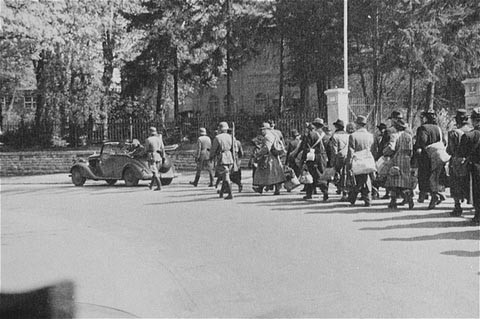
Deportation, Ioannina, 1943.
A friend pointed me to this small collection of photographs of the deportation by the Nazis of the Jews of Ioaninna, Greece, on March 25, 1943, to Auschwitz-Birkenau.
I have seen many moving photos of the deportation of Jews, including photos of the deportation from Würzburg of a group that included my great-uncle Leopold and his wife Irene in April of 1942.
But I don’t think I’ve ever seen one as wrenching as this:

And this one is pretty tough too — especially the child on the right.
It looks as though these photos captured the moment when the men were driven away.– Eric
Posted at 2:34 PM
How Times Have Changed!
W hich very prominent lawyer penned this endorsement of Michael Dukakis for the Democratic nomination in 1988, praising him for, among many other things, his repudiation of Al Gore’s “militaristic foreign policy”? (answer below the fold)
UNLIKE any other candidate, the voters know what to expect if they elect Gov. Michael S. Dukakis as their next president. Dukakis is the only Democrat in the race who has a proven track record of success, and he has also demonstrated the personal qualities of honesty, candor, and integrity that set him apart from his competitors.
Dukakis is the only candidate who has run a government. Sen. Paul Simon, Rep. Richard Gephardt, and Sen. Albert Gore ’69 have built their careers on Capitol Hill, while Jesse Jackson has never held elected office. Dukakis is the only one who has balanced a budget, formulated a legislative program, led a cabinet, and acted as an executive. He has learned the need for compromise and agreement, which will serve him well in Washington. He has drawn his experience from the act of governing, not sitting in a comfortable Washington office building worrying about PACs and interest groups.
Dukakis’ record as governor of Massachusetts illustrates a record of tangible achievement, rather than the theoretical–and at times fanciful–plans of his competitors. Fiscal prudence and compassionate, practical social programs have become the Dukakis trademark. Massachusetts has led the nation in its workfare programs, its housing and education initiatives, and in its insurance and health legislation.
And the governor is the only candidate who can make good on his promises for economic success. Under the Dukakis administration, the state became known as the “Massachusetts miracle” for its booming economic growth–employment hovers around 2 percent, three points below the national average. Dukakis has implemented policies which have fostered innovation and growth, while he has personally encouraged the partnerships between industry, government, and universities that have made Massachusetts one of the nation’s high-tech, export centers. Dukakis can rightfully claim some credit for transforming a state once called “Taxachusetts”–beset with high unemployment, crime, and a declining economy–into the nation’s top economic success.
UNLIKE Reagan, Dukakis’ management style displays a “hands-on” philosophy. The recent shake-ups in the Dukakis campaign hierarchy, in which Dukakis fired two of his most trusted advisors for unethical practices, show that for him, the ends do not justify the means. This is a refreshing and attractive attitude after eight years of the most scandal-ridden administration in history, presided over by a man who neither knows nor cares what his subordinates do in his name.
But Dukakis is not only running as governor of Massachusetts, but as a man who can apply his knowledge and expertise to national problems–such as trade, foreign affairs, and the environment. Dukakis rightly places himself against Gephardt’s call for sweeping protectionist legislation and instead calls for national attention on rehabilitating our weaker industries. Dukakis considers the best policies to be limited protection of only the most hard-hit industries–such as oil and textiles–only so long as to allow them time to catch up with existing technologies.
The governor’s vision comes through in his plan for a national energy program, which would help reduce our dependence on foreign energy production. This includes tax breaks for Texas oil producers and development of alternate energy supplies. This would decrease our dependence on nuclear energy, which Dukakis has fought in his battle against the Seabrook nuclear plant.
Dukakis has moved to develop a coherent foreign policy, one that recognizes that America can no longer dictate to the rest of the world. President Dukakis would use both negotiation and a newly-revamped and efficient military to live in a multipolar, not a bipolar, world. Perhaps what we need now is a president who can bring intelligence and good sense to foreign policy, not a strict ideology as a “hawk” or a “dove.” Dukakis would be an “owl.”
DUKAKIS has proved himself a “man of the people.” He rides to the office on the T and he buys his suits from Filene’s basement. Dukakis, in fact, has better proven himself to be “one of us” in the South than has Gore, whose Washington upbringing, prep school/Harvard ties and liberal voting record are taken as evidence that he has betrayed the South.
Dukakis has an excellent reputation for honesty and straight-forwardness, qualities which have deflected much of the moral criticism that has plagued the other candidates. America’s love for these virtues, which Reagan captialized on in his campaigns, shows the importance they hold for voters.
On many issues Dukakis shows fundamental disagreement with other candidates and he emerges with more of a discernable identity than others. He repudiates Gore’s militaristic foreign policy, Simon’s ludicrous public works-balanced budget proposals, and Jackson’s unfeasible visions.
Michael Dukakis is the man among all the presidential contenders who has consistently shown his desire to address the needs of all Americans. His record has not favored the rich or the poor, but has treated all fairly with an aim toward social justice and sensitivity from the government. His record as a chief executive and his inherent integrity show that he is the man who can succeed in this effort. We support him for the Democratic Presidential nomination.
— Eric
Continue reading “How Times Have Changed!”
Posted at 12:04 PM
John Yoo, Karl Bendetsen, Firing, and Hiring
S ome are mooting the idea of stripping John C. Yoo of his tenure at Boalt Hall, but I recoil in horror from the notion. I say this not out of any admiration for the legal advice he rendered while in the Office of Legal Counsel, nor because of any personal connection to him. (I met him only once, before his OLC days, when he was on the Federalist Society’s law school speaker’s circuit.)
I say it because firing academics to punish them for their views is abhorrent. I suppose I might think about it differently if Yoo were someday convicted of some sort of criminal offense for his OLC activities (which strikes me as very unlikely). But if Boalt Hall were now to fire Yoo, it would, I think, go down as one of the more serious blows to academic freedom in our nation’s history.
I guess this aligns me more with Sandy Levinson in the disagreement he is having at Balkinization with Stephen Griffin, who, as I read him, is arguing for Yoo’s dismissal.
Griffin’s analogy of Yoo to Karl Bendetsen subtly shifts the inquiry, however. He asks how we would respond if Bendetsen applied to teach a course on military law at our law school, and suggests that Boalt Hall will continue to have a Yoo problem so long as there are lots of people who would not hire Karl Bendetsen.
I would not hire Karl Bendetsen into a tenured or tenure-track position at my law school if he were circulating his CV after his stint in the Western Defense Command helping to engineer the incarceration of Japanese Americans.
But if he took a leave of absence from my law school to work in the Western Defense Command, and there ended up helping engineer that program, I would not fire him when he got back after the war.
(It’s worth noting, in this connection, that the Leflar Law Center, the home of the University of Arkansas School of Law, is named for Robert A. Leflar, a former dean who, as a government lawyer, helped to run the Jerome and Rohwer War Relocation Centers in Arkansas.)
It strikes me as pretty easy to make the case for not hiring John C. Yoo — and, it goes without saying, for not conferring on him the honor of a distinguished lectureship, as Canisius College very recently did.
Crossing the line to firing him would be a fateful step.– Eric
Posted at 11:12 AM
Glimpses.
S omebody just pointed me to these excellent high-resolution photographs of scenes from the incarceration of Japanese Americans in World War II.
I especially like the photos of the wall postings.– Eric
Posted at 2:23 PM
Some Thoughts About The Phrase “Concentration Camp”
J ennifer at Mixed Race America relates another episode in the seemingly endless debate over the use of the term “concentration camps” to describe what the U.S. government termed Japanese American “Relocation Centers” in World War II.
This is not a new debate. Indeed, it began while the camps were still open. Remember that in Korematsu v. United States, decided in 1944, Justice Roberts called them “concentration camps,” a phrase for which Justice Black took him to task.
At the level of ordinary usage, Justice Roberts had the better of the argument; it was Justice Black who was getting an early start on revisionism. In ordinary conversation, everyone from FDR down to the detainees in the camps called them “concentration camps” back then. Here, for example is an excerpt from an article from the NY Times in January 1943 about plans to recruit soldiers out of the camps:

But it’s not enough for us today simply to point out that people in 1942 or 1943 called them “concentration camps”; we are using the words in 2008, and the phrase took on a different meaning when the horrors of the Nazi genocide became linked it. To the average American today, “concentration camp” principally means “confinement site for genocide.” The camps for Japanese Americans were not confinement sites for genocide.
I guess I can see why, in the eyes of a person like “Older American Historian” (referred to in the post at Mixed Race America), the term “concentration camp” might seem like a suspect effort to depict the camps as places even worse than they were.
But that’s not why scholars use the term “concentration camp.” We use it chiefly for a different, and far better grounded, rhetorical reason: to defeat euphemism. The government clothed each step of the process of evicting and detaining Japanese Americans in sweet-sounding words of assistance: exile was “evacuation”; detention and scattering were “relocation.” The camps were “relocation centers” in government parlance. These were all Orwell-speak. And everyone knew it; hence the ubiquitous “concentration camp” in day-to-day conversation.
We have another purpose in using the term “concentration camp” — to remind readers and listeners (or to bring to their attention, if they’d never thought about it before) of what the American and the Nazi camps actually had in common: the forced warehousing of a racially defined enemy of the state. Justice Frank Murphy saw this common thread in 1943, when he wrote (in Hirabayashi v. United States) of the “melancholy resemblance” that the U.S. program against Japanese Americans bore to the treatment of Jews in Europe.
So there are definitely rhetorical reasons for using the term “concentration camp,” but “Older American Historian” apparently mistook them for an effort to capture genocidal meaning from the Nazi Holocaust. The points are principally to deny a legacy of American euphemism, and secondarily to emphasize the racial scapegoating that characterized the confinement.
None of this means that “concentration camp” is a term to be thrown about loosely. In my view, the term has become so laden with the connotation of genocide that scholars should not use it in speaking of or writing about the Japanese American experience without briefly explaining that the term is historically accurate, necessary to defeat euphemism, and not a claim of identity with the Nazis’ camps in Europe. But properly explained, “concentration camp” strikes me as an accurate — indeed, a necessary — term for the Japanese American “relocation centers” of World War II.– Eric
Posted at 3:38 PM
Memo to McCain: Repealing the Alternative Minimum Tax Will Increase Federal Revenues . . . Duh!
I t’s tax time, and many Americans are again feeling the pinch of the Alternative Minimum Tax — a tax calculation imposed long ago to insure that the wealthiest Americans paid taxes. Unfortunately, the AMT was not indexed to inflation, so over time, bracket creep brought it to the middle class.
What’s surprising to me is John McCain has not been on the stump demanding that Congress just eliminate the AMT. Yes, just repeal it.
Why? Because, according to McCain, tax cuts increase federal revenues. That is, tax cuts pay for themselves and then some. (Yippee!)
Supply-Side economic-types live and breath the truism that tax cuts actually increase growth in the economy and, hence, revenues to the Treasury.
So how much easier could the answer be in solving the AMT crisis (or any crisis really)? Just cut the damn AMT out of the Internal Revenue Code and . . . bingo! . . . Americans will start making more money and the federal budget will be balanced.
Isn’t that right? Isn’t that the way tax cuts have worked in America since McCain became one of those Reagan foot soldiers back in 1981?
So why isn’t the GOP demanding the repeal of the AMT on the ground that the damned tax-and-spend Democrat[ ] Party is once again in the way of progress?
Here’s a thought . . . maybe the GOP isn’t demanding the AMT’s repeal on Supply-Side grounds because the AMT is now a *middle-class* tax problem. It’s not like the high-enders will reap the big rewards from its repeal. And if the high-enders aren’t going to get oodles more money in their stockings at Christmas, then why bother?
My point? That the GOP — and John McCain — is full of shit on taxes and tax cuts.
Someone should call him on it . . . but I won’t be holding my breath.– shertaugh
Posted at 11:57 AM
Click Through To Her Notes If You Want To Read About The Mute Parrot.
T hink the life of a reporter for the NYTimes would be glamorous?
Think again.— Eric
Posted at 12:35 PM
Pandora!
I know that I must be the third-from-last person in the universe to learn about Pandora Radio, but I’ll mention it here just in case one of the other two might be reading.
Utterly brilliant. Fabulous. I lack the words to describe what a great idea this thing is.
You tell it which artists you like. It creates a “radio station” for you that features music that’s similar to what you like.
I gave it just a few hints, and it has just played for me, in succession, “Shot With His Own Gun” by Elvis Costello, “If Not for You” by Bob Dylan, and “Your Mother Should Know” by the Beatles. And now it’s playing Nick Lowe’s version of “I Knew the Bride (When She Used to Rock ‘n Roll)”. And it is often throwing in bands I don’t know well, like Weezer and Nada Surf.
And you can create multiple stations — so I have a separate roots reggae and ska station that I can listen to when I’m in the mood for that.
Damn! This is good stuff! Try it.– Eric
Posted at 12:24 PM
Tradition! (Sort of)
— Eric
Posted at 3:32 PM
“I was really glad they put my mom in a bed right across from where you were working!”
W hen I used to live in the NY area, I loved looking at the “missed connections” ads in the Village Voice. They were such a great glimpse into tiny little slices of people’s lives.
Now, of course, there’s craigslist, which does the same thing, only better.
So … ER docs at UNC, take note.– Eric
Posted at 1:44 PM
What Are “Intellectual Enrichment Activities” for a Tiger?
N ext time you are on the market for a pet, keep in mind this sage advice from eHow.com:
“Consider the practical aspects of having a pet tiger. You will need to find a veterinarian who will treat your big cat, have access to large quantities of raw meat, have a cage and space large enough for your tiger and be able to provide physical and intellectual enrichment activities. Plan ahead for these aspects of owning a pet tiger before buying one.”
Yes, you read right. This is advice on owning a pet tiger.
 Did you know it’s legal in some states to own a pet tiger? I did not until my visit this weekend to the Carnivore Preservation Trust outside of Pittsboro, North Carolina. North Carolina is one of the states where tiger ownership remains legal. Many of the cats at the Carnivore Preservation Trust are animals rescued from irresponsible people who started out thinking it’d be nifty to have a two-ton huge wild cat in their backyard.
Perhaps there is a persuasive libertarian case to be made for permitting private residential ownership of tigers, but I haven’t yet heard it. The risks to neighbors, the owners themselves, and of course to the cats, are mind-boggling.
If, perchance, a legislator in the State of North Carolina is reading this, I have a question for you: Why has the state not yet outlawed the private residential ownership of big cats?
UPDATE: Here’s an example of what I’m talking about.
— Eric
Posted at 12:21 PM
A Book Tour for the Ages.
R ecently I was flipping through my dad’s law school yearbook (U. of Pennsylvania, Class of 1956) and came across the page devoted to a lecture series called “Booknight” that the law school ran in those days. Authors would come in and talk about their books.
The photo on the page captures quite a gathering of intellects.

Yes, that’s Learned Hand, lecturing alongside Paul Freund and F.S.C. Northrop about his (Hand’s) then-recent book “The Spirit of Liberty.” (I’m sure Professor Clarence Morris of Penn Law was no slouch either, but I’m not familiar with him.)
Now that’s what I call a book tour.– Eric
Posted at 3:21 PM
Bill Murphy and the Hidden Inner Layer of Academic Freedom
L ate last September I blogged about my UNC colleague Bill Murphy shortly after he passed away. I focused on the remarkable and tragic story of how he was driven out of his teaching position at Ole Miss for refusing to condemn Brown v. Board of Education.
Recently I learned the less well-known story of how Bill was effectively driven out of the University of Missouri in 1970-1971. It’s quite a tale. It illustrates well that some of the most potent threats to academic freedom can come from inside, rather than outside, the university.
The short paper is available via SSRN.– Eric
Posted at 10:07 PM
Gun Rights in Georgia
Y esterday’s Supreme Court gun-rights argument in Heller caused me to query how the issue of gun rights was viewed by early 19th century state courts.
An 1846 ruling from the Georgia Supreme Court seemed the most interesting. The case is called Nunn v. State. The issue was whether a state law regulating the sale of hand guns and knives for use as concealed weapons, under which the defendant was convicted, was unconstitutional.
First, the Georgia court ruled that the 2nd Amendment applied to the states, just as — citing one of its earlier rulings — the 5th Amendment’s double-jeopardy clause applied to the states. No incorporation theory at work there. Nor any reference to the 9th Amendment. Just a textual argument that many of the protections of the Bill of Rights apply to limit the powers of both the federal and state governments:
I am inclined to the opinion, that the article in question does extend to all judicial tribunals whether constituted by the Congress of the United States or the States individually. The provision is general in its nature and unrestricted in its terms; and the sixth article of the Constitution declares, that the constitution shall be the supreme law of the land, and the judges in every State shall be bound thereby, any thing in the constitution or laws of any State to the contrary not withstanding. These general and comprehensive expressions extend the provisions of the Constitution of the United States, to every article which is not confined by the subject matter to the national government, and is equally applicable to the States. . . .
The right of the people peaceably to assemble and petition the government for a redress of grievances; to be secure in their persons, houses, papers, and effects, against unreasonable searches and seizures; in all criminal prosecutions, to be confronted with the witness against them; to be publicly tried by an impartial jury; and to have the assistance of counsel for their defence, is as perfect under the State as the national legislature, and cannot be violated by either.
Next, the court ruled that the 2nd Amendment established a fundamental right.
Finally, the court ruled that a portion of the statute at issue was constitutional:
We are of the opinion, then, that so far as the act of 1837 seeks to suppress the practice of carrying certain weapons secretly, that it is valid, inasmuch as it does not deprive the citizen of his natural right of self-defence, or of his constitutional right to keep and bear arms. But that so much of it, as contains a prohibition against bearing arms openly is in conflict with the Constitution, and void; and that, as the defendant has been indicted and convicted for carrying a pistol, without charging that it was done in a concealed manner, under that portion of the statute which entirely forbids its use, the judgment of the court below must be reversed, and the proceeding quashed.
I don’t foresee the Supreme Court ruling in Heller that the 2nd Amendment protects the right to carry weapons openly. On the other hand, that the 2nd Amendment protects an individual right seems clear in all the early cases on the topic. Just as was a state legislature’s power to regulate the manner in which that right was exercised.– shertaugh
Posted at 10:30 AM
The Heller Line
A s Orin Kerr continues to cover the line of people waiting to see oral argument tomorrow in the Heller case on the Second Amendment, it occurs to me that this is a line you really don’t want to cut.
Of course, it’s not all bad. On a cold night like tonight, you’d probably want to be near somebody packing heat.– Eric
Posted at 11:49 PM
“An awful way to spend the day … unless they get in the kitchen and make a great meal after all the bitching.”
A nn Althouse announces an upcoming conference on feminist legal theory at the University of Wisconsin, and all misogynist hell breaks loose in her comments, especially from some of her most frequent commenters. Nauseating stuff … and Ann remains curiously silent (except to note that the program features some men, and to encourage people to hit her blog’s tip jar). Ann has blogged quite a bit about her own feminism, and has criticized some powerful people whom she sees as feminism’s false friends. So it’s hard to understand her wanting to provide a forum for the sort of filth her commenters are spewing.
My theory: this was a ploy to drum up fodder for conversation at the conference. She set up a blank screen for her commenters to reveal themselves. If this was her strategy, it was brilliant, and it worked.
UPDATE: Ann sees her comment threads differently from me. She says, in a comment (to this thread, posted at 6:53 p.m.), “many commenters are finding academic feminism ridiculous and that is not misogyny. To call it misogyny is to put your lack of thinking and writing skills on display.”
I was the first to call some of the comments misogynist, so I guess I’m among those displaying allegedly poor thinking and writing skills.
Here are some comments from the original thread that strike me as misogynist (as distinguished from simply critical of academic feminism):
11:20 a.m.: a feminist meeting is “another meeting with a lot of older women wearing shoulder pads.”
12:24 p.m.: men attending a feminist meeting are there “to get laid.”
12:39 p.m.: inquiry about anal sex.
12:44 p.m.: “if they want to be taken seriously, they need a bra-burning.”
2:38 p.m.: a meeting of feminists is a place to “pick up babes.”
3:24 p.m.: women at the meeting are probably just “bitching” and can make up for this only by cooking a good meal … and the meeting will have lots of “lebanese” (which is to say, lesbians) with armpit hair and shag haircuts.
7:23 p.m.: a joke about womens’ breast sizes
7:24 p.m.: a reprise of the anal sex theme, with a new reference to oral sex.
1:00 a.m.: a commenter raises the idea of ejaculating on a female law professor’s hair.
7:49 a.m.: a screw-in-a-light-bulb joke in which a woman serves a man dinner and drinks and then allows him to have intercourse with her from behind, with a picture of a now-famous prostitute taped to the back of her head.
11:59 a.m.: a fantasy, complete with linked
visualillustration, in which a cartoon woman’s head is removed, and then she is reduced simply to legs and a vagina. (Yeah, “visual” was redundant.)
— Eric
Posted at 3:45 PM
My Apology to Andrew Sullivan
I n October, I wrote a post about “Andrew Sullivan’s Crusade Against HRC.” HRC is of course Hillary Rodham Clinton.
Today, I offer my sincerest apology to Mr. Sullivan.
I just finished dashing off a note the Clinton campaign telling them that I’ve reach the point of no return with her and will not vote before I vote for her.
Why? In the past two weeks, she’s made Obama as dirty a word as Starr. She’s refused to renounce Geraldine Ferraro’s serial racism. She’s the first presidential primary candidate in my adult life to successfully turn Democrat against Democrat since 1968. When the likes of George Wallace were slicing and dicing the Dixiecrats into Republicans and McCarthy was rallying the kids against their parents. She’s turned this race into a freakin’ nightmare.
Andrew . . . you were dead wrong about “W” Bush. Dead wrong about Iraq.
But you are spot on about the Clintons.
— shertaugh
Posted at 6:22 PM